← Notes

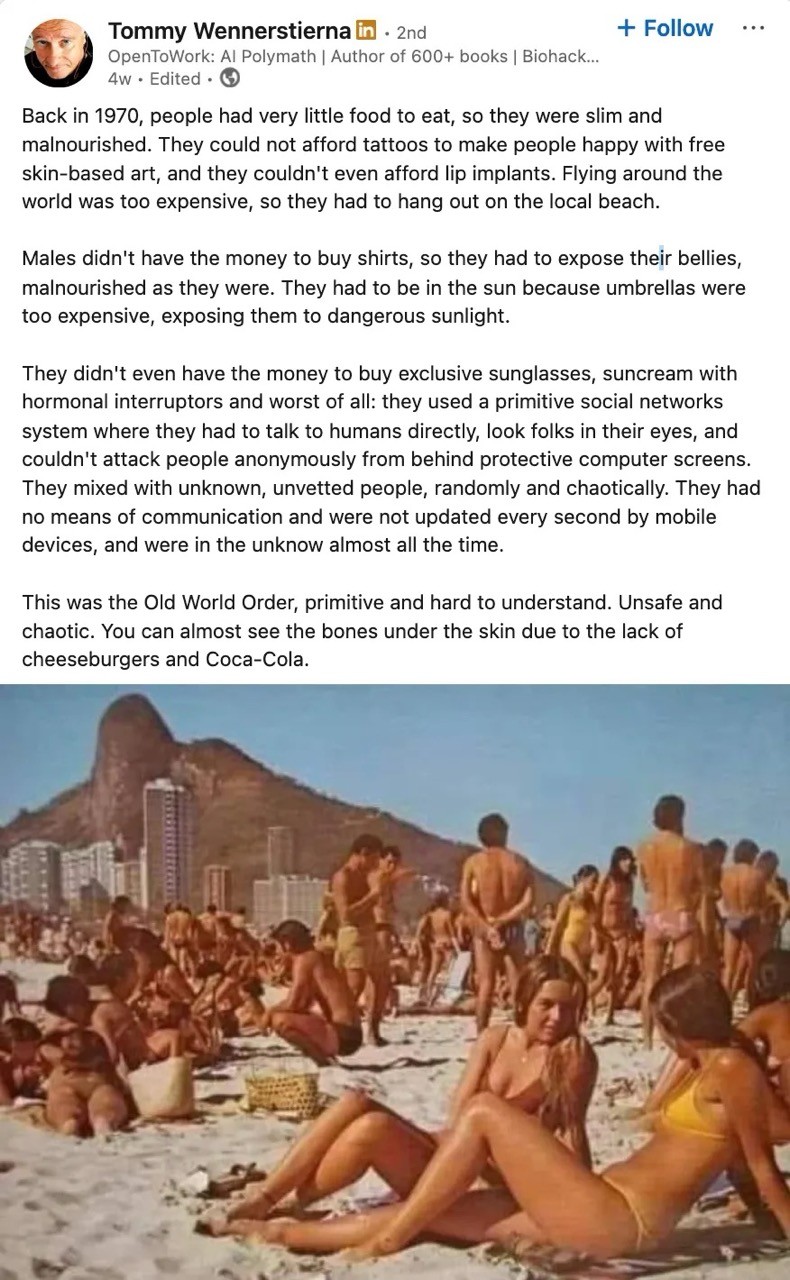
Two LinkedIn posts sparked my curiosity last week. The first was Tommy Wennerstierna’s brilliant take on a 1970s beach photo in Brasil, chuckling at the ways we used to live, compared to our always-on lives now. The second, from anthropologist Dr. Lollie Mancey, explored how AI has created “asynchronous, predictive time, where the future arrives before we’ve even asked for it.”
Together, they crystallized something I’d been feeling but couldn’t name: we’re conducting a teensy little experiment in human consciousness. Do we know what we’re doing?
Let me show you what I mean.
Alex is a successful accountant in suburban Phoenix. Over three years, his home value has stagnated while similar houses across town have soared. What Alex doesn’t know is that his everyday digital behaviors have been quietly working against him. Every time he shopped at Dollar General instead of Target to save money, every time he posted “these gas prices are ridiculous” on NextDoor, he was feeding data to mortgage algorithms that decided his neighborhood was economically declining. His practical financial choices created a self-fulfilling prophecy of stagnation.
Melanie is a healthy 34-year-old whose health insurance premiums jumped 40% because an algorithm noticed she bought different groceries (shift in diet), had different sleep patterns (new baby), and visited medical offices a touch more than before the baby (routine checkups). The AI turned normal life changes into financial punishment.
Nobody would choose a world where grocery shopping affects mortgage rates or where having a baby triggers insurance penalties. Although Alex and Melanie are fictional, their scenarios reflect realistic patterns in algorithmic decision-making.
We just wanted better emails. Or no emails. And maybe more cat videos.
The beach that time forgot
There’s that beach photo making the rounds, with people lounging in Rio, playing, talking, genuinely present. The caption sarcastically describes their primitive condition: “They had no means of communication and were not updated every second by mobile devices, and were in the unknow almost all the time.”
What if it was simply…human?
I’m writing this on a weekend when I’m attending a demolition derby with my daughter. It’s a beautifully inefficient experience. Cars will smash in unpredictable ways. It will be loud and dirty and magnificently messy, dozens of junkers on their final breath, raging and wheezing spectacularly for no meaningful purpose.
Are she and I preserving something important, or just being sentimental? Would we even know if or when we’ve crossed over?
The time thieves
AI has stolen our relationship with anticipation, and it’s not clear that we understand what we’ve lost. Your smart home adjusts the temperature before you realize you’re uncomfortable. Your fitness app recommends rest long before you feel tired. Your shopping cart pre-fills with items you’ll probably need based on what you bought last month.
What Mancey calls predictive time — where ‘the future arrives before we’ve even asked for it’ — captures something deeper. This isn’t time travel, it’s the elimination of time as a space for human consciousness to operate.
Awkward.
For millennia, we’ve lived in moments of not knowing. When would the bus come? Would we like this restaurant? What song should we play next? These weren’t inefficiencies; they were the cognitive spaces where human experience happened. The anxiety, the anticipation, the small surprises, the occasional disasters that became life stories.
We’ve compressed these gaps to zero.
The corporate blueprint
BCG’s Where’s the Value in AI? report reveals something unsettling: companies spend 70% of their AI implementation effort on “changing task flows, redefining human roles, and building agent-centric processes from the ground up.”
In plainer English: we’re systematically training humans to think in machine time rather than human time.
That’s just…weird.
When they say “core business processes,” they mean the fundamental ways humans interact with institutions. When they say “reshaping,” they mean replacing human rhythms with algorithmic optimization. When they say “agent-centric processes,” they mean designing work around AI’s capabilities rather than human ones.
BCG found that leading companies generate 62% of their AI value by “reshaping core business processes” — not just automating tasks, but redesigning entire systems so that human patterns become minimal, measurable, and ultimately obsolete.
The language is bloodless, but the implications are vast: we’re being methodically edited out of our own reality.
How is this not fucking weird.
The participation trap
This transformation feels elegant because it’s voluntary. Each optimization arrives as a gift. Who doesn’t want their commute route calculated on the fly, their food delivered with precision, their music curated to their exact preferences?
Maybe all this works too well. As our algorithms become better at predicting what we want than we are at wanting it, that changes what it means to be human. Alex’s neighborhood decline, Melanie’s insurance penalty…these aren’t bugs, they’re early symptoms of humans trying to live in algorithmic time.
We’ve created an odd participatory dictatorship: we participate enthusiastically in systems that gradually eliminate our participation in our own experience of time. The mechanism is rather elegant — algorithms reward engagement over reflection, prediction over surprise, efficiency over the productive confusion of not knowing what comes next.
Epitaphs of efficiency
Let’s follow this trajectory to its logical conclusion:
“Here lies Margaret. She never once had to ask a stranger for directions.”
“Beloved husband. His groceries were delivered with 99.7% accuracy.”
“She touched many lives, mostly through her optimized LinkedIn outreach campaigns.”
That grocery one really captures the human spirit, doesn’t it?
We don’t know what we don’t know
Perhaps the most notable aspect of this transformation is how it happened without anyone’s explicit permission or even awareness. No election was held on whether society should restructure human experience in this way.
We solved the ancient problem of not knowing what comes next. But it’s possible that not knowing what’s next was never actually a problem — it was how human minds work.
Those people on the Brazilian beach weren’t suffering from information poverty. They were rich in something we’ve optimized away: the ability to exist in present-tense uncertainty, to let time unfold at human speeds, to be surprised (or not) by their own lives.
We’re all living inside this experiment now. Enjoy the ride.